“Ceramics, especially porcelain, offers everything that I need; it can be both abstract yet able to convey representational ideas. It is tactile, intimate, and constantly challenging.”
MONIKA PATUSZYNSKA
MONIKA PATUSZYNSKA is a contemporary ceramic artist who grew up in Warsaw, Poland in a time where workers rights were defined by the solidarity movement and the collapse of the Berlin war marked the end of the Cold War and the beginning of European unification She grew up in the 1980’s when the Ksiaz Porcelain Factory was considered the most modern porcelain factory in Europe boasting state of the art production equipment and processes, employing over 1400 people at its peak. When PATUSZYNSKA finished her studies in 2000, she worked within the factory amongst the workers,” the kilns, machinery, casting tables and dividing walls” (Bechtold, 2015 p93) making her own work and taking advantage of what the factory had to offer.
As communism faded and Poland embraced capitalism, the economic impact on free market reforms was painful. The ceramic industry was one of many casualties of these historical times as better-paid workers and increased costs of production outstripped profits. Many factories succumbed, to the slow death of liquidations and bankruptcy including The Ksiaz. The factory was finally closed in 2004 and remained empty until it was demolished in 2012. Just before its demise PATUSZYNSKA returned to Ksiaz to embark on a new art project, her aim to explore the past through the present times. However she embarked on the project with mixed feelings as shared in an interview with Monika Patuszynska from C File in 2014,
“ For some time after closing before they are demolished and disappear completely- the factories doze in some storage state of suspension in an odd in between. At first the between seemed unbearable to me. No hustle and bustle. No heat. No rhythm of pumps. No colours that I was so accustomed to. Divorced from time. I came up with casting not to feel an intruder any more, but to pay my way into being there, to become a part of it and to tame the new situation. I decided to cast the abandoned moulds in the abandoned factory. The essence of the project is casting directly on the factory floor; a gesture that reinstates the original function they lost, thereby losing their raison d’etre and turning nothing more than halls waiting for demolition. It is a kind of “closing the eyes rite for me, a completion of a rite of passage”. (Clarke, 2014)
PATUSZYNSKA began the journey playing out her memories within the abandoned porcelain factory and attempted to retrace the topography of the place by dropping the role as an observer and to engage in the process of making. In the opening scene of the short film ‘OPERACJA KSIĄŻ ‘ (Stadnik,2012) documenting her artistic process, the footage reveals a melancholic almost haunting stillness to the cavernous space in which she explores. The artist walks amongst the moss and mould, the growing patches of green and brown, the oxidised and rusting metal pipes, wood splintered and rotting and water seeping through the cracks like the drips of a limestone cave eroding what is below. PATUSZYNSKA interrupts the process as she sees the opportunity in the despair as she rummages through what seems to be endless stacks of plaster moulds. Some are in tact others discarded and broken; the leftovers that once were used to create fine porcelain dinnerware for the well to do. She looks for those imperfect pieces, the damaged and crippled that have been exposed to the elements for nearly a decade. Pieces that tell the history and decay of the place and have potential to serve her art. Patuszynska further states (Clarke, 2014), “The objects themselves are not the main focus of the project. They are used as a medium that carries a record of the entire history of the factory in all its stages.” She is inspired by the process of making, most of all by the accidents and the difficulties of working in porcelain and the possibilities of the void.
TECHNIQUE
The Orphans and Bastards series:


Patuszynska slip casts her chosen moulds using the original mould, neither adding nor subtracting which she refers to as an orphan. She sees them as the intellectual achievements of the factory and her process gives them the attention they are deprived of. In recording the decay of the objects she is reflecting on memory, the passage of time and changing society. The distinction and uniqueness of her work give new meaning to the abandoned factories “ just as the way a pearl changes the way of seeing a mollusc”.
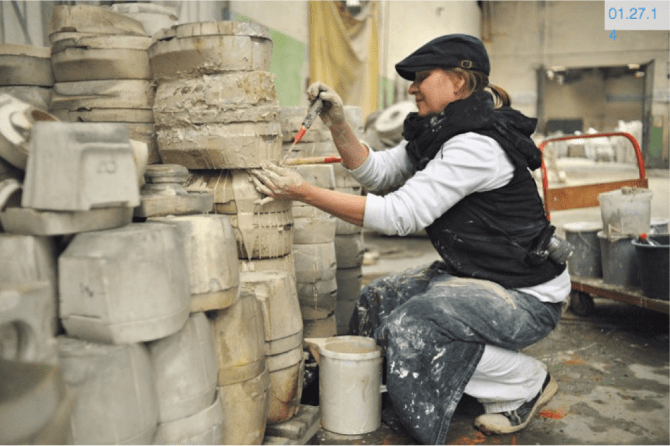
Using a staple gun, she fixes the sides of the original moulds together, sometimes filling the cracks with clay. PATUSZYNSKA then pours the slip into the cancerous moulds within the cavernous surroundings allowing the viscous fluid to drip through the cracks to the concrete floor. As the slip sets and working within the cold and frigid temperatures, the artist pulls apart the moulds and at times attacks the surface of the mould with an angle grinder as the marginalised almost organic forms are revealed. The orphan is born ready for the kiln.
This process can be seen in her sugar pots series, oval dishes and cups. Each piece telling the story of its change in state and the process of its decay. The moulds that are partly devoured by water give spectacular results.
In a second process, which she tags, The Bastards are different as they are interventions. Here Patuszynska takes the moulds and cuts them into new forms stapling and taping the plaster pieces together, however she adds nothing from her own hand apart from the act of assemblage, everything remains exactly the same, every mark, every scar and flaw remains. Nothing added nothing removed. (
In her later series, Patuszynska modifies the plaster moulds by sawing, smashing and breaking them into pieces then reassembling to form “completely new species”. (Kurgan, 2014) Sometimes manipulating the cast itself. There is a sense of industrial production and seriality with her work as she reuses the same moulds over and over again, letting the decay, damage of the moulds mark the process of time rather than have a series of perfectly produced carbon copies twenty or thirty times.
The reuse and reinterpretation of assembling disused components in new and varied contexts is now an accepted practice in the contemporary art world. Italian artist Paolo Polloniato skilfully slip casts abandoned classic moulds with underground and popular culture to create new and exciting sculptural forms giving them “visibility under a new spotlight” (Giovanni, p27.2014). Sin Ying Ho, a Chinese American artist “fuses together a complex porcelain assemblage that comments on globalisation and cultural disjuncture in popular and high culture” (De WAAl, p126)
Bechtold observes (2015), ” This totally new and fresh approach where borders between industry, craft and art are diffused….Now suddenly the product is individual, intimate and non commercial.. and the meaning changes from usability to one of contemplation.”
IMAGES:
Above are the unique slip cast ceramic sculptures from ‘Operartion Ksiaz’. The first phase of Monika Patuszynska’s project, Orphans and Bastards.
- Monika Patuszynska; Working in the Ksiaz Porcelain Factory. (Photo Grzegorz Stadnik)
- Sugar Pots, Allegro. 15-16 x11-15 x10cm (Photo Monika Patuszynska)
- Bastard Series (2012-2013): h33, 29cm, parian ware, 1260 C, piec elektryczny (Photo Monika Patuszynska)
Bibliography:
Bechtold, J. (2015). Monika Patuszynskas Operation Ksiqz. Ceramics: Art and Perception, [online] 99(2015), pp.92-97. Available at: http://www.patuszynska.art.pl/fotolog/15_03_CAP.pdf [Accessed 8 Aug. 2016].
Clarke, G. (2014). Exhibition | Monika Patuszyńska: Orphans and Bastards | CFile – Contemporary Ceramic Art + Design. [online] CFile – Contemporary Ceramic Art + Design. Available at: https://cfileonline.org/exhibition-monika-patuszynska-orphans-bastards/ [Accessed 8 Aug. 2016].
Coirier, L. (2014). Monika Patuszynska: Extended Interview. [online] TLmagazine. Available at: http://tlmagazine.com/monika-patuszynska-extended-interview/ [Accessed 8 Aug. 2016].
De Waal, E. and Clare, C. (2011). The pot book. 2nd ed. New York, N.Y.: Phaidon, p.126.
Giovannini, R. (2014). Paolo Polloniato Orchestra Leader. Ceramics: Art and Perception, 95(2014), pp.27-29.
Kurgan, A. (2014). Interview | Agnieszka Kurgan Speaks with Monika Patuszyńska | CFile – Contemporary Ceramic Art + Design. [online] CFile – Contemporary Ceramic Art + Design. Available at: https://cfileonline.org/interview-agnieszka-kurgan-speaks-monika-patuszynska/ [Accessed 8 Aug. 2016].
Stadnik, G. (2012). OPERACJA KSIĄŻ Rekoncyliacja 2012. [online] YouTube. Available at: https://youtu.be/SB7EevDmvh0 [Accessed 8 Aug. 2016].
Patuszynska., M. (2016). Monika Patuszynska. [online] Patuszynska.art.pl. Available at: http://www.patuszynska.art.pl/artist.html [Accessed 8 Aug. 2016].
Puls Ceramics. (2016). Puls Ceramics – Monika Patuszynska. [online] Available at: http://www.pulsceramics.com/exhibitions/monika-patuszynska-2014/ [Accessed 8 Aug. 2016].
 Red Beetle Design