Assessment Summary
This assessment task requires you to complete two non-conventional ‘portraits’ that explore ideas of ‘association/embodiment’ and ‘dissociation/disembodiment’ in relation to the body:
(i) One portrait should be an observational painting from life, i.e. a self-portrait using a mirror, or a painting of a sitter. Minimum scale of portrait: 50 x 40cm.
(ii) The other portrait should respond to a ‘mediated body’ (a model), e.g. a mannequin, anatomical model, computer-generated model, or a 3D model made from paper, plasticine or cardboard. It is recommended that you work from a printed photograph that you have taken of the model, taking into account considerations such as the lighting, angle, backdrop, etc., in order to situate your ‘portrait’ within a meaningful context. Minimum scale of portrait: 50 x 40cm.
Each of your two ‘portraits’ should employ a painting process that somehow visualises ‘bodily association’ or ‘dissociation’. In the context of portraiture, ‘association’ can be interpreted as the appearance or feeling of ‘inhabiting one’s body’ and being connected to its physical and sensory capabilities. It may also allude to the capacity for ‘embodied experience’, i.e. the body’s ability to be cognizant of space and time while immersed in an activity. Conversely, ‘dissociation’ may refer to disconnection from the body, or distortions in bodily perception. Dissociation or disembodiment may also suggest existing without the body, i.e. its metaphysical qualities, or an idealised, virtual or immaterial body. How do bodies become modified and (re)constructed through diverse imaging processes and what can this say about contemporary perceptions of the body?
WEEK 10: Assessment Task 3: Association/Dissociation
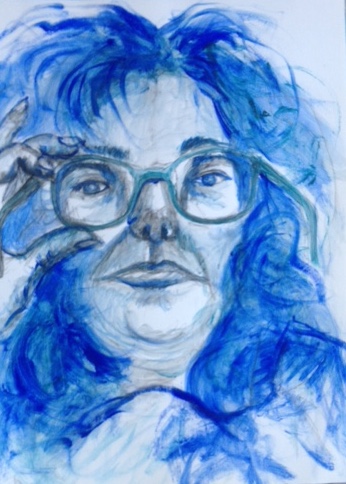
Studio intensive: A3 Self-portrait using a mirror. Paint a self-portrait from observation using a mirror. The painted portrait should employ a monochromatic palette and be a minimum scale of A3. The aim is to explore either ‘association/embodiment’ or ‘dissociation/disembodiment’ as an idea, considering how your painting process might contribute to different interpretations.
WEEK 11: Assessment Task 3: Association/Dissociation
Practice-led research, consultations.
WEEK 12-14: Consolidation of Practice
Consolidation of practice-led research for Assessment Task 3: Association/Dissociation
ASSOCIATION:
In the context of portraiture, ‘association’ can be interpreted as the appearance or feeling of ‘inhabiting one’s body’ and being connected to its physical and sensory capabilities. It may also allude to the capacity for ‘embodied experience’, i.e. the body’s ability to be cognizant of space and time while immersed in an activity.
CONCEPTUAL IDEAS:
(i) One portrait should be an observational painting from life, i.e. a self-portrait using a mirror, or a painting of a sitter. Minimum scale of portrait: 50 x 40cm.


For the association portrait I was originally inspired by a friends photograph they had taken of themselves and shared on Facebook. I found the image amusing and interesting in its distortion as we can create a different version of ourselves by simply playing with reflections in front of the mirror.
My glasses are such an important part of my look, my ability to see and function in life without hindrance. I wear bifocals and at times my vision can become distorted depending on how close I am to an object or how intense the ambient light is. I am constantly aware of seeing my environment through a frame, but not aware of how others perceive these until I hear a comment on their colour or take them off! Experimenting with this distorted view through my frames, acting out my various moods, I took a series of photographs in my bathroom mirror. I imagined how others may perceive who I was as I played and reposition my frames to clean them, to rub my tired eyes or simply to rest as I try to make sense of my blurry world which is like looking through fogged glass.
Thinking of my blurry world I have decided to paint my portrait without my glasses on to see if I can capture this sensory experience and the slight anxiety of not seeing the world clearly.
Image to paint-“The frustration of seeing”
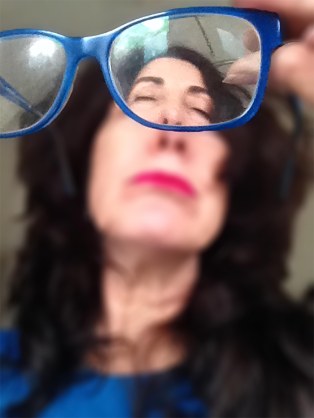

Examples of the blurred self.
PROCESS:
ARTIST INSPIRATION:
Other inspiration for my application has come from my printing glass where layers of colour and texture are revealed from beneath revealing something more than just the image. I’ve decided to treat the surface of the canvas like I would in printmaking, then adding layers and building the portrait out of the textured surface.

DISASSOCIATION:
(ii) The other portrait should respond to a ‘mediated body’ (a model), e.g. a mannequin, anatomical model, computer-generated model, or a 3D model made from paper, plasticine or cardboard. It is recommended that you work from a printed photograph that you have taken of the model, taking into account considerations such as the lighting, angle, backdrop, etc., in order to situate your ‘portrait’ within a meaningful context. Minimum scale of portrait: 50 x 40cm.
CONCEPTUAL IDEAS:
I was drawn to the plaster cast of my nose which was created by my surgeon before I had a Rhinoplasty many moons ago (1993). I’ve always kept this as a reminder of my past self, evidence of the nose I was born with. It represents my heritage and my genetic inheritance which I no longer recognise as part of my identity.I have detached from this emotionally and psychologically and look at this strange plaster model objectively as it no longer represents my reality.
The ability to have a nose fixed, repaired, altered and reinvented is a reality of contemporary living. If it’s broke, then I’ll get a new one! All that is required is the skill of the surgeons knife and a fist full of cash. The purchase is buying into the society’s ideas of perfection which are strewn across advertising billboards, TV screens, the internet and other forms of mass media. The need to fit it and look good especially for women is enormous. To dissociate the end outcome with the actual process is not simply a cut and paste, but is a major surgical intervention. Images are freely available on the internet with Dr commentary and clear explanation of the process. It is quite disturbing and can cause revolution, but the end results! ” Its all so worth it!”


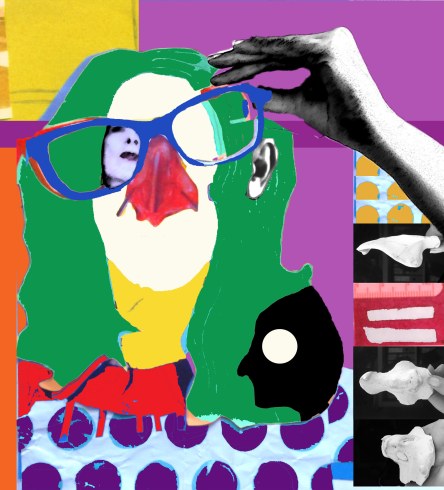
I further played with the images I already had and created a collage of my face by cutting out the shapes and recombining them with a silhouette image of my partners face and images of rhinoplasties in action.
ATTEMPT 1:
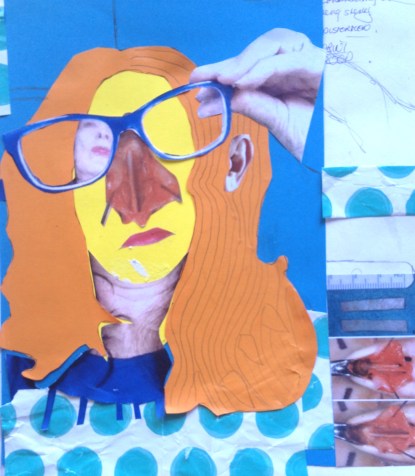
I played further with the colours to finalise my concept. I’m also imagining that I will sculptural gesso to flesh out the flesh wound to enhance its rawness and bloodiness. The collaged images will be included in the work as I’ve found them to mirror the mass production.
ARTIST INSPIRATION:

Baldessari_Nose and Ears etc Two
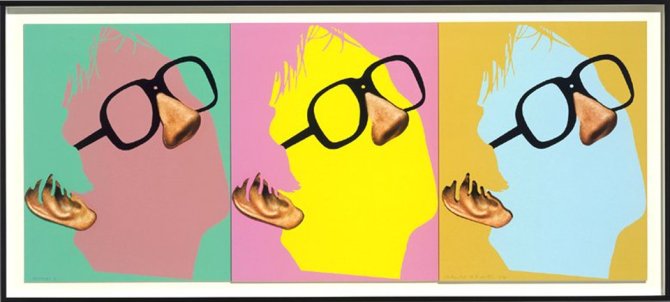
John BALDESSARI- One Face, Three versions with nose, ear and Glasses. 940×640
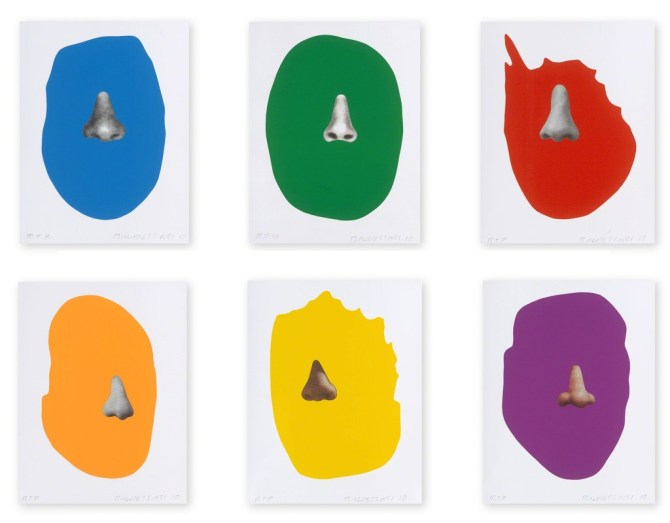
John BALDESSARI, “Set of six Nose-Silhouettes,”2012
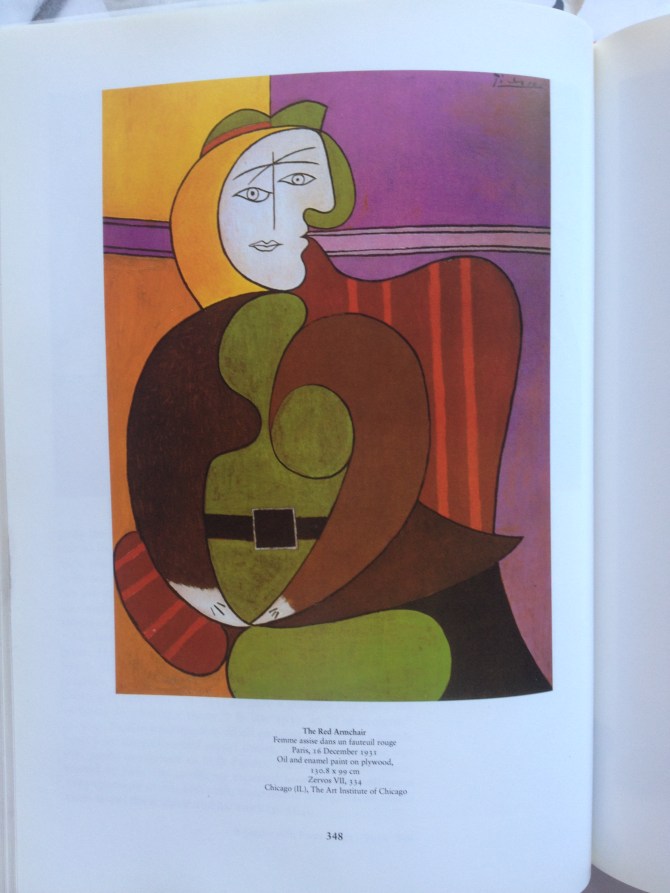
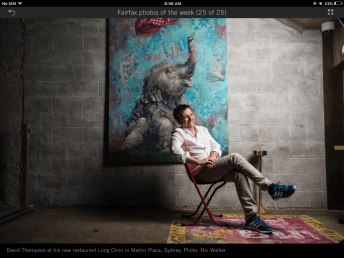
Pablo Picasso, The Red Chair. Paris 16 dec, 1931. 130.8 x 99cm
WEEK 12: Group critiques of Assessment Task 2: Fragmented Body
3-minute presentation of research file on an historical or contemporary example of a ‘fragmented body’.
See research file for details:
WEEK 15 :Final Work
ASSOCIATION:”The frustration of seeing”
Acrylic on canvas. 30X40CM
I initially rendered the composition straight from the image which makes life so much easier when there isn’t an abundance of time. I used Acrylics for this piece and forgot how quickly they dry! It was a challenge working and blending the skin tones before the previous stroke dried. I use matt and gel medium and this helped with the the viscosity, the transparency and the workability of the paint. I managed to paint this in about 5hours. From preparation of the image to the final work. I decided to leave the undercoat of the canvas as it complimented the subject matter and the colour of my glasses and dress. Very enjoyable.


DISASSOCIATION:”The frustration of imperfection”
Acrylic, plaster cast, magazine cutouts on canvas. 30X40CM
My final work is a collage/ multimedia pieces that attempts to capture my general feelings of unrealistic perfection. Its a joke! To dissociate with the ideal and to think that looking perfect, having that perfect nose, being forever young is achievable. I’ve depicted myself as a collaged version of myself complete with my plaster cast “old”nose and images of rhinoplasty surgery and my sculptural plaster cast. My internal self is hidden in the corner of my frames looking outwards behind my old reality, scared and concerned of what others would think of my gigantic profile.

 Red Beetle Design