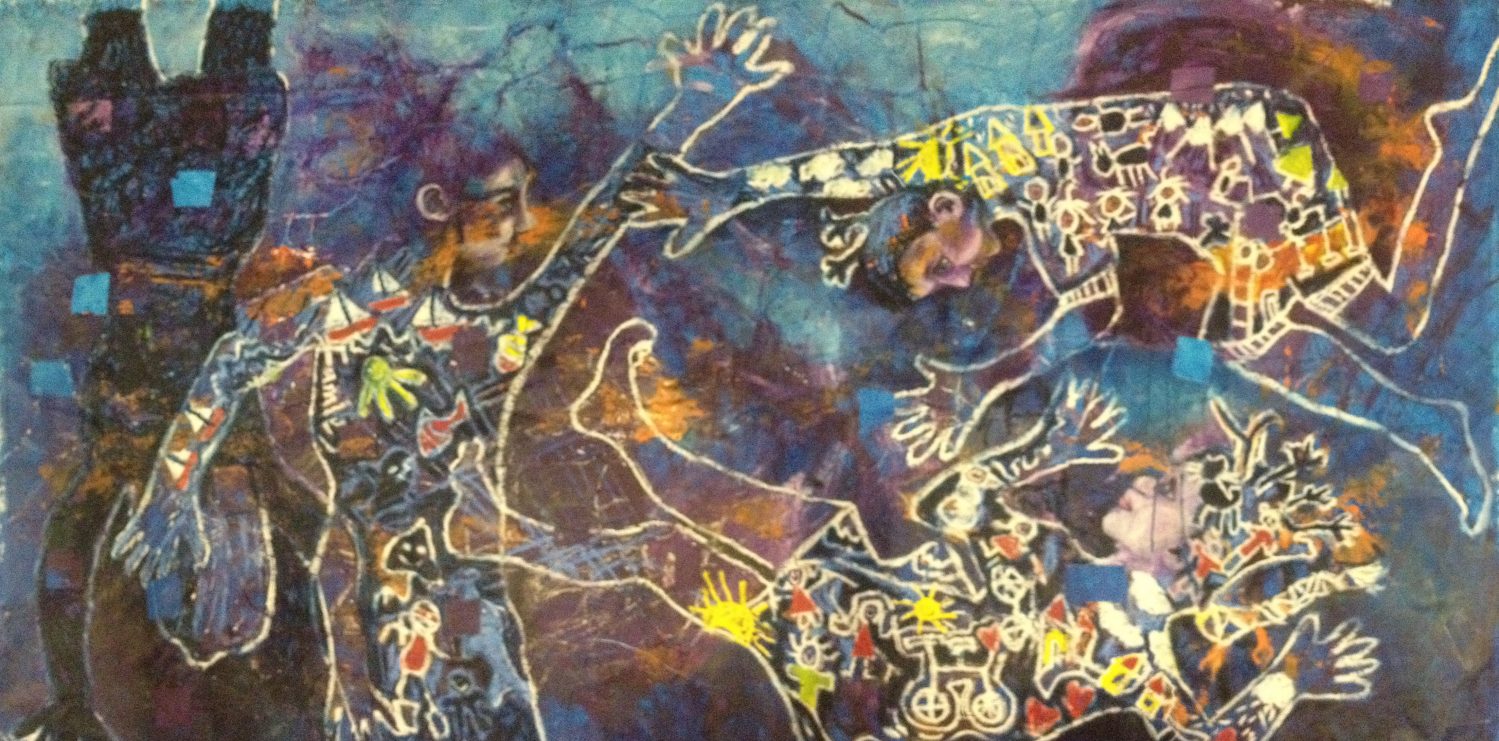
Title: The Fragmented Body
Due: Friday 14th October (Week 11)
Submission details: Research file to be uploaded to Moodle
Your painting for this assessment task must be supported by a Research File with a bibliography, documenting your investigation of historical and contemporary examples of ‘the fragmented body’, concept development, and practice-based experimentation. The Research File should evidence both your textual research (through the inclusion of relevant, fully-cited quotes from articles and books, etc., accompanied by your own comments) and practical research (through the inclusion of visual documentation of your studio processes).
THEMES:
- The bathroom and bathing as a metaphor-
- The fragmentation of time
- Memory, history and fractured reality
“One cannot simultaneously view front and back sides of the body, nor witness the millions of processes, exchanges, and interactions that take place within its biological interior.”
Quoted from the exhibition statement for Exquisite Corpus: Interacting with the Fragmented Body (2008), Johnson Museum of Art, Cornell University, Ithaca, New York.h[p://museum.cornell.edu/exhibi-ons/view/exquisite-corpus.html
The bathroom and bathing as a metaphor.
Brett Whiteley
I particularly looked at the bathroom series by Brett Whiteley for inspiration with my composition. This series of paintings were completed during a return trip to London when the Whiteleys settled into a new studio from 1963-1964. His series of paintings of the single figure of his wife Wendy in the bath are obscured in “warm reds and honey colours combined with the acid colours blues and greens of the bathroom interior.” (Pearce, 1995) The lusciousness of her skin tones and broad sweeping shapes of the limbs and torso are evocative, sensual and capture the tactile and intimacy of the scene. The simple, fragmented treatment of the shapes painted in blocks of colour, the regular pattern of the standard square tiles and the whimsical addition of taps, shower heads and drain holes are “untroubled feasts for the eye”(Wack, 2014). I am interested in Whiteley’s colour palette and painterly treatment of his compositions and the freeness and expressiveness of his conte and charcoal marks. The abstraction of the form, the gentle curves of the bath and the absence of the face allows the viewer to be with the figure and to identify with its serine , languid state. Whiteley’s work alludes to its cubist influences such as the paintings’ unfinished look, the concept of passage, and the phenomenology of fragmented forms.
Bathing and the fractured body parts in Whiteley’s work can be interpreted as a metaphor for renewal and healing. The Bath becomes a sanctuary for renewal from a busy world, the removal of sin, corrupt and toxic thinking. A place to unwind, to feel the contentment of the warm water and to be bathed in new ideas . Whitley’s work is still, a frozen content moment that allows the subject to just be.
NB: (Image missing label: Nude at Basin c 1963)
Artists such as Pierre Bonnard’s bath paintings influenced Whiteley who in keeping with his philosophy of domestic bliss, depicted the figure idealised and frozen in time if not realised in real life.
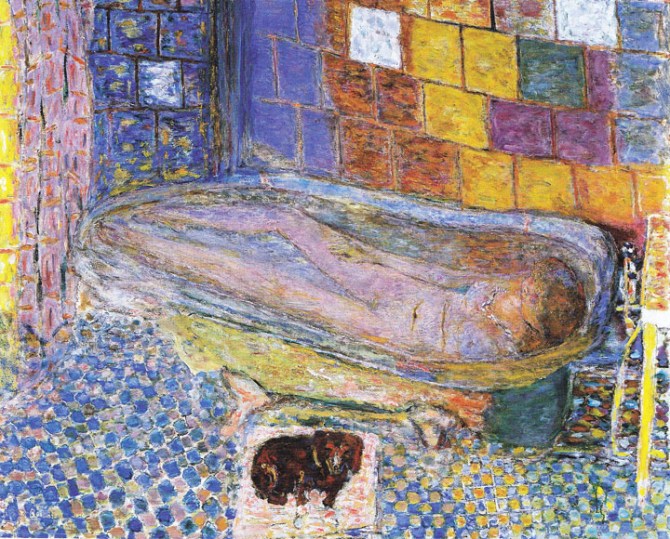
Pierre Bonnard, Nude in Bath (1941-46)
Fragmented Time:
TIME is an ILLUSION according to EINSTEIN. We can see time passing by watching the hands on a clock, but what is time actually measuring? Einstein discovered that time can travel at different rates, he proved a hidden connection between motion in space and passage of time. In reality the more you have of one, the less you have of the other. Time is moving more slowly for the person who is moving. At slow speeds the impact on time is so tiny that it cannot be observed, however over distance the difference becomes acute.
With the discovery of the link between space and time, they are unified together as space time and exist as a fourth dimensional structure. The sharp difference between the past, present and future is an illusion. Every event that has happened can be revisited theoretically. The concept of now might be seen as the tick of the clock in London, the faraway pigeon in Venice, or sitting in a bath in Sydney all happen simultaneously on a single slice of spacetime, moment after a moment. Strangely when motion is added, the analogy of a slice of time goes out of the window.
There are different ways to cut time into different spaces of time. Time can be described as slices at different angles and not parallel. Motion slows the passage of time, clocks no longer agree. The angle of time increases or decrease depending on what direction you are going. It then angles towards the past or future. Time is then a combination of space, time and distance. It is then proposed that the past, present and future all exist as real as the present moment. The past is not gone, the future is not gone. Everything that will happen or has happened all exists.
Julie Fragar
Julie Fragar’s paintings are a documentation of the traces of memory, history and fractured reality. She presents a fractured narrative that slips between the past, present and future slowly revealing her complex and multilayered images. In her recent Grey Paintings exhibition (30.03.2016 – 23.04.2016) her conceptual ideas align with the space time continuum.
“It has been noted that history is a construct and that no account of an historical event is ‘believable’ because it only exists in the imagination of an individual who remembers it, or who writes it down: its accuracy is always deeply suspect and never finite. Fragar’s paintings are a confirmation of this. They ‘reveal’, and yet they obfuscate; they disclose and yet they mystify – in the same way that our minds attempt to make sense of the past, the present and the future.” (nkngallery, 2016)
Fragar’s images are like a blurred mirror evoking a sense of frustration as it becomes a cat-and-mouse game of identifying the fragmented bodies. There is a sense of uncertainty , a balancing act in identifying the ambiguous forms in her work. The layering of so many images moves between identification to confusion as the viewer tries to understand the “mechanism of analogic seeing”. the question of what happens when the eye is baffled, and needs to go in search of analogies in order to understand what it sees.
Unlike Whiteley’s work where there is a sense of calm and contentment, Fragar’s paintings evoke feelings of tension, over thinking, complexity and a degree of stress and anxiety.
Francis Picabar
Not dissimilar from Julie Fragar, Picabars work captures a sense of movement through space and time. There is also a sense of the ephemeral as the figures are often contemplative and on the move.
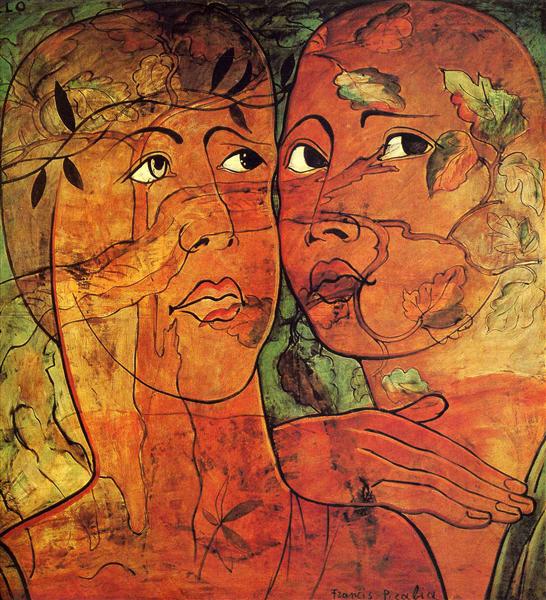
Aello Francis Picabia Date: 1930 Style: Surrealism Series: Transparencies Genre: mythological painting
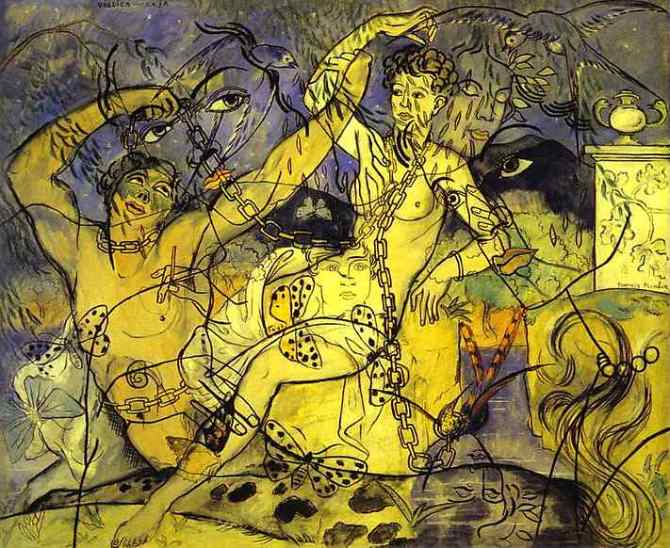
Villica Safe Francis Picabia Date: 1929 Style: Surrealism Series: Transparencies Genre: figurative Media: oil, canvas Dimensions: 180 x 151 cm
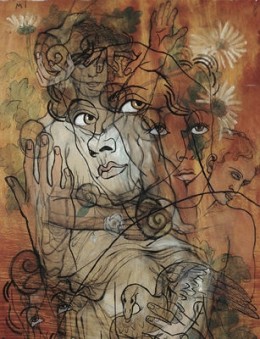
“MI” (1929)
What does this mean for the interpretation of my
own work?
Classwork and Experimentation
STUDIO INTENSIVE
I initially used a drawing I had created at home for my first studio intensive. My partner took many photos of me in the bath in various poses, taken in quick succession as we had to go to the airport. No time! In this example I superimposed two drawings over the top of what another to create a sense of fragmented movement and stillness.


September 9, 2016
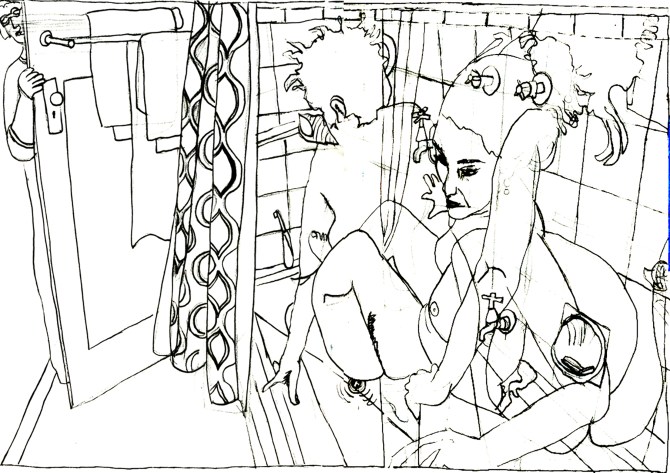
In response to the various class exercises, my drawings and experimentation I drew up my proposed concept for this assessment. I created my composition in photoshop with images I had taken images of my subject previously and combined them in such a way to create a feeling of fragmentation in space and time. My concept is to reveal that there is no stillness, there is always movement, something happening. No present, no past and no future. Thoughts are on the move, fragmented psychological rational and irrational thinking, a to do list, somewhere else to go, You better get ready…. The following slide show depicts the work completed during class.
The bathroom is usually associated with cleansing, healing a place of solitude to be reflective and to just be,. But the figure at the door, the urgency to move, thinking is fragmented.
The viewer is sneaking a view, allowed to stare at the naked form in a state of motion, trying to identify the parts. There is no chance for the eyes to rest as the image becames a problem solving exercise as reflected in many cubists works. However the timeless consistency of the bathroom, never changing cocoons the figure.
Further experimentation
I played around with the composition looking at Brett Whiteley’s work in particular and his use of space. I read that a composition that utilises space, cuts off and places the figure to one side evokes a sense of beauty. Additionally, once I felt comfortable with my composition.
I traced out my final composition and experimented with the application of media. i also used the filters in photoshop to explore colour possibilities to assist me in my decision in the how to paint this!
A LITTLE ABOUT THE ARTISTS:
FRANCIS PICIBAR:
“Francis Picabia: Our Heads Are Round so Our Thoughts Can Change Direction is a comprehensive survey of Picabia’s audacious, irreverent, and profoundly influential work across mediums. This will be the first exhibition in the United States to chart his entire career.
Among the great modern artists of the past century, Francis Picabia (French, 1879–1953) also remains one of the most elusive. He vigorously avoided any singular style, and his work encompassed painting, poetry, publishing, performance and film. Though he is best known as one of the leaders of the Dada movement, his career ranged widely—and wildly—from Impressionism to radical abstraction, from Dadaist provocation to pseudo-classicism, and from photo-based realism to art informel. Picabia’s consistent inconsistencies, his appropriative strategies, and his stylistic eclecticism, along with his skeptical attitude, make him especially relevant for contemporary artists, and his career as a whole challenges familiar narratives of the avant-garde.”
https://www.moma.org/calendar/exhibitions/1670?locale=en
FINAl WORK:

SUMMARY NOTES
- The reign of terror and the French revolution-
- Borrowing the term from Gestalt psychology, “the plane of the verticality is the plane of Pregnanz…the hanging together of the coherence of form…further this vertical dimension, in being the axis of form, is also the axis of beauty’ (p22)
- “Wider implications of fragmentation of the social, psychological, even metaphysical fragmentation that so seems to mark the modern experience” (p23)
- Ebb and flow of motion of modern living, floating existence as described by Marshall berman (p24)
- A sense of alienation a sense of being cut off. Meaningless flow of modern living. (p37)
- No narrative , beginning or ending
BIBLIOGRAPHY:
- Elkins, James (2012) Analogic, from a draft of a rewritten, expanded version of the book Pictures of the Body: Pain and Metamorphosis (1999) Stanford University Press. (Available at COFA library: CFA 704.942/49)
- Aaronson, D., Fortenberry, D. and Morrill, R. (n.d.). (2015) Body of art. Phaidon Press, London, New York.
- Kemp, Martin & Wallace, Marina (2000) Spectacular Bodies: The Art and Science of the Human Body from Leonardo da Vinci to Now University of California Press (exhibition catalogue, Hayward Gallery London). For a review of this exhibition see: Leonardo, Vol. 35, No. 4, Aug 2002, p. 455. (http://muse.jhu.edu.wwwproxy0.library.unsw.edu.au/journals/leonardo/v035/35.4nake.pdf)
- Stafford, Barbara M. (1991) Body criticism: imaging the unseen in Enlightenment art and medicine Cambridge, Mass.: MIT Press
- Alexander, C. (2007). Faces of War. [online] Smithsonian. Available at: http://www.smithsonianmag.com/history/faces-of-war-145799854/?no-ist [Accessed 9 Oct. 2016].
- Artgallery.nsw.gov.au. (2009). Archibald Prize Archibald 2009 finalist: self-portrait in the bathroom discussing beauty, bukowski and brett whiteley with my ex, now a stripper, who likes to dress as wonder woman by Anthony Bennett. [online] Available at: http://www.artgallery.nsw.gov.au/prizes/archibald/2009/28753/ [Accessed 9 Oct. 2016].
- C, S. (2014). Charlotte Corday and the Murder of Marat. [online] Madame Guillotine. Available at: http://madameguillotine.org.uk/2014/07/16/charlotte-corday-murder-marat/ [Accessed 9 Oct. 2016].
- Fitzpatrick, C. (n.d.). Review of Linda Nochlin’s The Body in Pieces: The Fragment as a Metaphor of Modernity. [online] Available at: http://static1.1.sqspcdn.com/static/f/1497936/25699819/1416777381217/Linda+Nochlin.pdf?token=UDdOYGQ7X58fJLdBZiWRgRI1Xvc%3D [Accessed 16 Oct. 2016].
- Hume, Y. (2014). Atrophy. [online] Yang-En Hume. Available at: http://www.yang-enhume.com/atrophy.html [Accessed 9 Oct. 2016].
- Jill Soloway on The Female Gaze | MASTER CLASS | TIFF 2016. (2016). https://youtu.be/pnBvppooD9I: TIFF.
- Nochlin, L. (1996). The Body in Pieces: The Fragment as a Metaphor of Modernity. The Journal of Aesthetics and Art Criticism, 54(4), p.410.
- Nochlin, L. (2001). The body in pieces. London: Thames & Hudson.
- Pearce, B., Whiteley, B., Robertson, B., Whiteley, W. and Hayman, C. (1995). Brett Whiteley. New York: Thames and Hudson.
- Stafford, B. (1991). Body criticism. Cambridge, Mass.: MIT Press.
- Wikipedia. (2016). Bathing. [online] Available at: https://en.wikipedia.org/wiki/Bathing [Accessed 9 Oct. 2016].
- Wikipedia. (2016). The Death of Marat. [online] Available at: https://en.wikipedia.org/wiki/The_Death_of_Marat [Accessed 9 Oct. 2016].
 Red Beetle Design