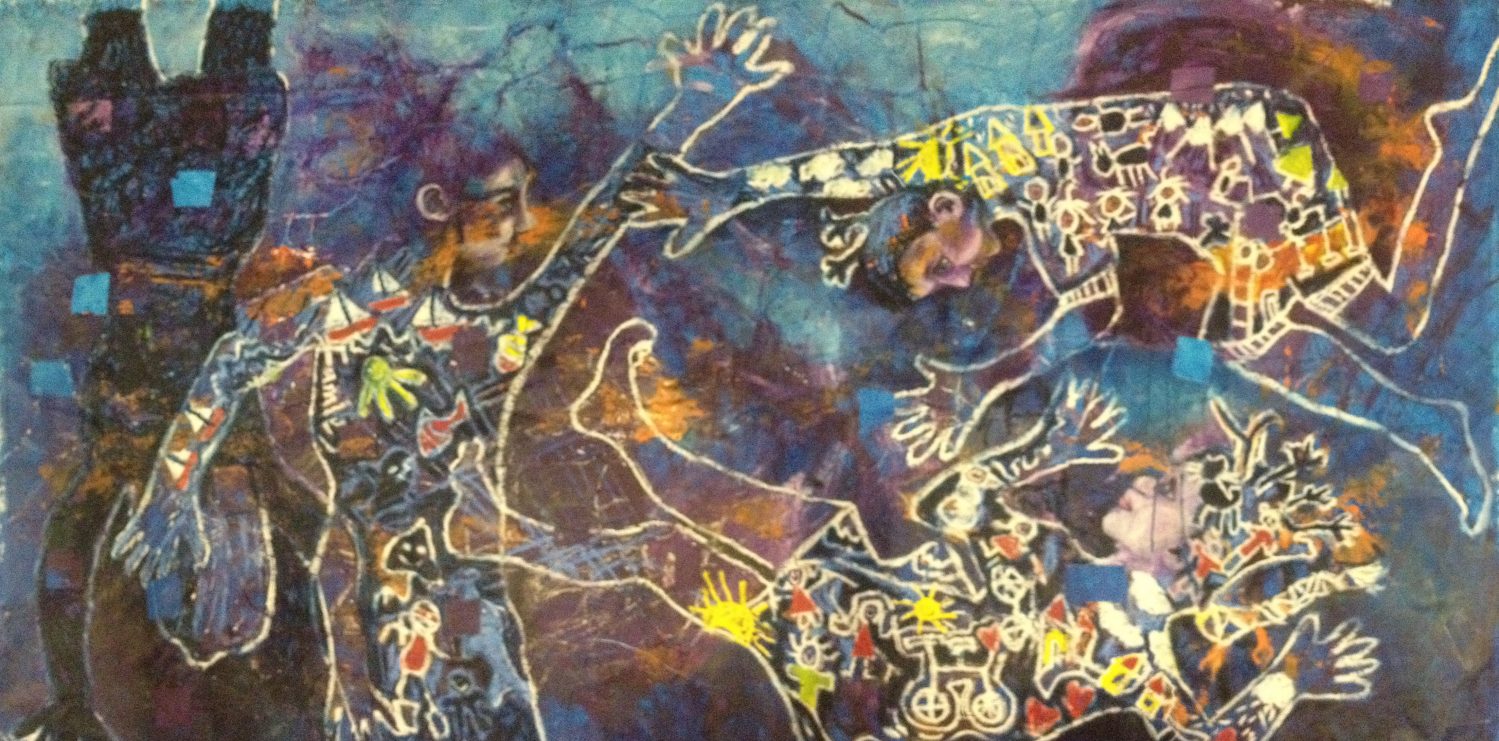
Assessment Task 2
Assessment Summary
“One cannot simultaneously view front and back sides of the body, nor witness the millions of
processes, exchanges, and interactions that take place within its biological interior.” (From the statement for Exquisite Corpus: Interacting with the Fragmented Body, Johnson Museum of Art, Cornell University, Ithaca, New York, 2008.)
Bodies are perceived, analyzed, and identified according to their constituent fragments (think of biopsies and other samples taken for medical testing, microscopy, fingerprint analysis, cells, DNA, facial recognition, etc.). According to Bojana Kunst, “The body can never be depicted as a perfect whole; quite the contrary, it is always present as a fragment only.”
For this assessment task, you are to research a cultural, psychological, medical or scientific context in which the body is encountered as a “fragment” or through a process of fragmentation. Explore historical and contemporary contexts for your chosen theme, e.g., in art, literature, etc. Your research is to lead to a painting that involves fragmentation as a methodology (e.g., collage, assemblage, composite imaging, close-up detail, enlargement, division, distortion, mutilation, breakage, incision, etc.) and as a concept (e.g., fragmented identity/cognition/sexuality/gender; disease, (dis)figuration, hybridity, transformation, etc.).
Research File
Your painting for this assessment task must be supported by a Research File with a bibliography, documenting your investigation of historical and contemporary examples of ‘the fragmented body’, concept development, and practice-based experimentation. The Research File should evidence both your textual research (through the inclusion of relevant, fully-cited quotes from articles and books, etc., accompanied by your own comments) and practical research (through the inclusion of visual documentation of your studio processes), and must be uploaded to Moodle by the end of Week 11 (Friday 14th October).
Presentation:
In Week 12, you are to give a 3-minute presentation on one historical or contemporary example of ‘the fragmented body’ and how your chosen example has informed your own practice.
References for Assessment Task 2:
- Elkins, James (2012) Analogic, from a draft of a rewritten, expanded version of the book Pictures of the Body: Pain and Metamorphosis (1999) Stanford University Press. (Available at COFA library: CFA 704.942/49)
- Body of Art, (2015) Diane Fortenbury & Rebecca Morrill (eds.) Phaidon Press, London, New York.
- Kemp, Martin & Wallace, Marina (2000) Spectacular Bodies: The Art and Science of the Human Body from Leonardo da Vinci to Now University of California Press (exhibition catalogue, Hayward Gallery London). For a review of this exhibition see: Leonardo, Vol. 35, No. 4, Aug 2002, p. 455. (http://muse.jhu.edu.wwwproxy0.library.unsw.edu.au/journals/leonardo/v035/35.4nake.pdf)
- Stafford, Barbara M. (1991) Body criticism: imaging the unseen in Enlightenment art and medicine Cambridge, Mass.: MIT Press
 Red Beetle Design